
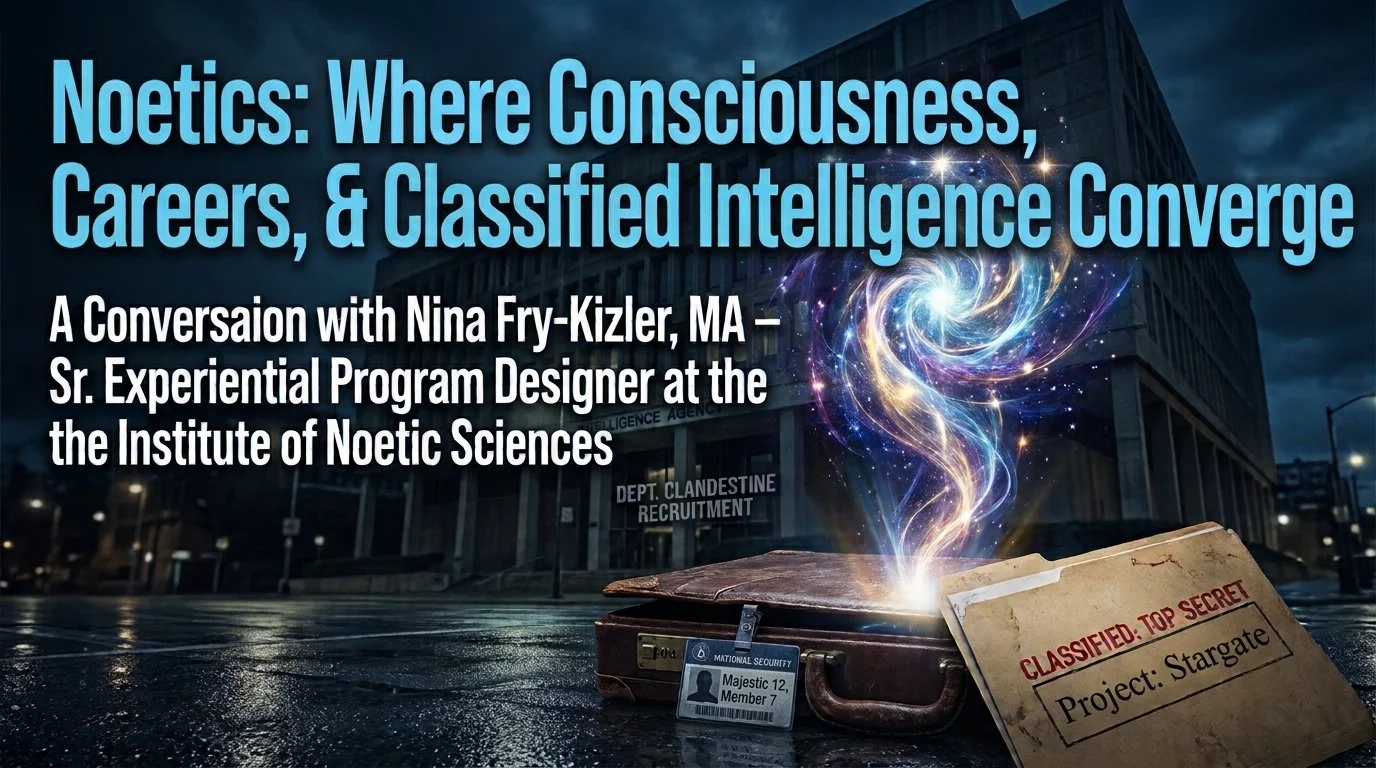
An Interview in Noetics: Where Consciousness, Careers, & Classified Intelligence Converge
A Conversation with Nina Fry-Kizler, MA – Sr. Experiential Program Designer at the Institute of Noetic Sciences and TCOIA Advisor
By Harish V., MBA, SRFPE, TCOIA Executive Chairman
The Council on Interdisciplinary Advancement
October, 2026
The Council on Interdisciplinary Advancement’s Executive Chairman, Harish V., sits down for an interview with Nina Fry-Kizler, MA, Sr. Experiential Program Designer at the Institute of Noetic Sciences
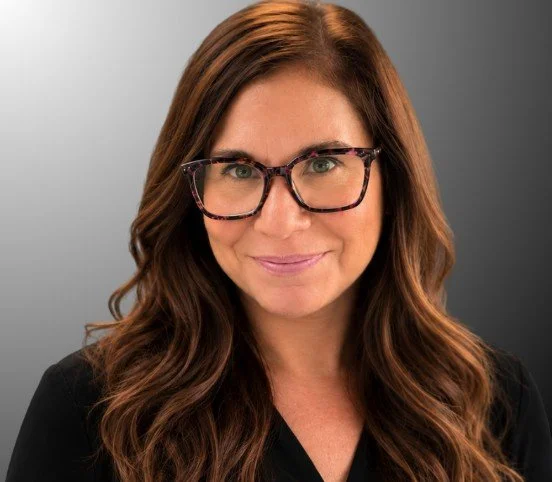
Nina Fry-Kizler, MA, Sr. Experiential Program Designer at the Institute of Noetic Sciences
Harish: Nina, thank you so much for speaking with me! We were talking via email about why The Council on Interdisciplinary Advancement [TCOIA] was interested in noetics. Our members had never heard of the field before. I stumbled onto it through reading and studies that I would later learn fit under “noetics.” Then I came across IONS [Institute of Noetic Sciences].
I wanted to focus on the career paths taken by current members of IONS. Your career reflects a unique blend of disciplines. You have managed programs at the GW Institute for Spirituality and Health, conducted clinical research at California Pacific Medical Center, and even served as a birth doula. Currently, you are a professor of holistic health at John F. Kennedy University and Senior Experiential Programs Designer at IONS.
For professionals in the TCOIA network and the broader audience who are siloed in their current roles and perhaps have never heard of noetics, how would you explain noetic science from your own perspective? Can you give a brief overview of what you do at IONS? Could you also talk about how your experiences, both professional and personal, have informed your perspective on human consciousness, health, and holistic transformation, leading you to the field of noetics?
Nina: The simplest way I describe noetic science is that it’s the scientific study of inner experience and ways of knowing that don’t always fit neatly into our conventional models of mind and consciousness. That can include intuition, direct knowing, interconnectedness, altered states, transformative experiences, and questions about whether consciousness is entirely produced by the brain or may be more fundamental than that.
At IONS, we focus on researching these phenomena and provide educational and experiential offerings to help people integrate the research into their day-to-day lives. What I really appreciate about IONS is that we don’t have to choose between scientific rigor and mystery. We can say, “This experience was meaningful and real to me,” while still asking, “What do we actually know? What else might explain it? What does the research show?” I believe that balance is very important.
My role at IONS is basically to serve as a bridge between the science of consciousness and the human experience of it. I help translate research and noetic ideas into educational programs, workshops, curriculum, experiential practices, and community conversations. I spend a lot of time asking questions like: How do we make this understandable and accessible without oversimplifying it? How do we let people experience an idea directly rather than just hear a lecture or read a research paper about it? And how do we keep the material grounded and intellectually responsible?
My path here was definitely not linear! I’ve worked in spirituality and health, clinical research, higher education, birthing work, curriculum development, and program design. Some of those things may initially appear unrelated, but they are all asking versions of the same questions: What helps people change and experience transformation? What supports healing? How do meaning, belief, relationship, the body, and consciousness affect how we live? Noetics gave me a home for questions I had been carrying across a lot of different fields.
Harish: That’s an excellent point you make about validating experiences and exploring them further, as opposed to other fields of science that may simply brush them off. Heisenberg and Bohr famously advocated for the idea that quantum events are random. It doesn’t mean they aren’t real or don’t exist; it just means that there are natural occurrences that may or may not be replicable, but they are very much “real.” You do incorporate a great deal of that in your work. It frequently spans both side-by-side research and curriculum creation, whether it was managing clinical research projects like MAMAS [Maternal Adiposity, Metabolism, and Stress], publishing on ecological medicine, and overseeing the Worldview Explorations Project. As Science Liaison at IONS, how do you take complex empirical research and translate it into practical, experiential programs like Noetics 101 or The Possibility Accelerator Experience? How much of that process and approach was in place when you started, and how much innovation and improvisation did you introduce? What prior experience did you draw upon to innovate and improvise?
Nina: A lot of my job is translation, but not just translation in the sense of making science easier to understand. I’m interested in translating research into actionable practices that people can actually do something with.
I usually start by asking: What is the most important idea here? What does the research genuinely support? And then, what might someone experience, reflect on, or practice that would help them understand that idea from the inside out?
That experiential piece matters a lot in noetic education because we’re often talking about things like intuition, attention, worldview, imagination, connection, or inner knowing. You can explain those concepts beautifully, but at some point, people need an opportunity to notice their own experience.
There was already a strong foundation for experiential education at IONS when I came into this work. What I think I’ve brought more intentionally is a learning-design lens: clearer developmental arcs, stronger connections between research and practice, more attention to pacing and participant experience, and more explicit discernment about what we know versus what we’re exploring.
My teaching background helped enormously. So did clinical research, honestly. Research teaches you to be precise about claims. Teaching teaches you that precision alone is not enough - people need context, relevance, and an entry point. Much of my work lives right in that intersection.
———————————————————————————————————————————
Harish: At TCOIA, we regularly interact with early and mid-career professionals who feel trapped in rigid workplace scripts, defining their identity strictly by job titles and anchor biases, as we talked about in our email. From a noetic and mind-body perspective, how can working professionals from all walks begin to dismantle, or at least de-prioritize these societal norms and discover that there is “more to life” without abandoning their careers? Another way to think about it is: how can they place less emphasis on the minutiae of life, which includes over-obsessing about work and routines, and focus on more meaningful experiences? I know it’s a loaded question, but feel free to answer as you’d like!
Nina: I don’t think the answer is necessarily to make a dramatic change to your life [to] “find your true calling.” Sometimes that just becomes another pressure-filled story we tell ourselves.
A more useful starting point may be noticing where we’ve confused a role with an identity. “I’m a lawyer,” “I’m a scientist,” “I’m a manager” - those things may be true, but they’re not the whole truth of who we are.
Harish: I 100% agree with you. I questioned it but never changed how I would introduce myself by my job, title, and company in the past. In the last few years, I started to introduce myself differently each time by interests, being family-oriented, spiritual, etc. It was the concept of “interconnectedness” that we had spoken about before and that I’ve read about when researching Noetics.
Nina: One of IONS’ guiding hypotheses is that everything is interconnected, and that embodying an awareness of that interconnection can reveal information and energy not limited by space and time and profoundly amplify transformation, innovation, and well-being. If we take that perspective seriously, then the way we relate to ourselves, our work, our colleagues, and our environment matters. In a sense, everything is relationship.
A noetic approach invites us to bring more awareness, curiosity, intention, and discernment into those relationships. That doesn’t necessarily mean changing careers. It might mean bringing a neglected part of yourself into your current work, mentoring someone, making room for creativity or contemplation, or simply noticing when productivity has become the only measure of value.
Harish: I love that. Starting small with making little changes to everyday life here and that can sometimes make the biggest difference.
Nina: I’m a big believer in small experiments. When we change how we show up in relation to our work and the people around us, we may also change the meaning, quality, and experience of the work itself. You don’t have to know the whole next chapter - sometimes you create a little space, pay attention to what shifts, and let that information guide what comes next.
———————————————————————————————————————————
Harish: I completely agree. That is a great segue to the next question. In your decade-plus as a professor at John F. Kennedy University, you advocated for and fostered cognitive flexibility, self-awareness, and holistic stress management. For anyone who is deeply entrenched in the traditional corporate or scientific/academic hamster wheel, what is the easiest, most practical habit or mindset change, which integrates intuitive thinking and noetic awareness into one’s professional and personal lives?
Nina: Probably the simplest thing is to create a little space between experience and interpretation.
We’re constantly making very fast meaning out of what happens: “My boss didn’t respond, so she must be unhappy with me.” “This project failed, so I’m bad at this.” Or on the other side, “I have a strong feeling about something, so it must be true.”
Harish: All too familiar…story of my professional life!
Nina: A noetic approach starts by paying closer attention to direct experience before rushing to a conclusion. What actually happened? What am I noticing in my body? What am I sensing intuitively? What story did my mind immediately create? And what else could be true?
Harish: Definitely. Many professionals have become familiar with the concept of Mindfulness, but it’s often presented in pieces and in a very clinical, corporate, one-size-fits-all format. It was a good start to get people to stop what they’re doing and start taking time to think during work and stressful times to recalibrate, but obviously there is a lot more to do to achieve that optimal mind-body and consciousness awareness.
Nina: That pause makes room for different ways of knowing - rational, emotional, embodied, intuitive - while also making room for discernment. To me, noetic awareness isn’t about privileging intuition over evidence or trusting every feeling without question. It’s about becoming more sensitive to how information shows up for us, while holding our interpretations lightly enough to stay curious.
Even thirty seconds of that can shift the quality of a decision, a conversation, or our relationship to the situation itself.
———————————————————————————————————————————
Harish: Definitely, healthy skepticism and questioning is important. That applies to all facets of life, in TCOIA’s case, career deliberation and planning. Moving to my next question, at TCOIA, we love exploring cross-industry and cross-sector cooperation and even transitions. At IONS and within the broader field of noetic science, do you see virtual reality applications and simulations as an integral part of experimentation and observation of non-local consciousness studies, or any other technologies and/or fields that are being married to noetics to further the advancement of study?
Nina: Absolutely. I think one of the most exciting things happening in consciousness research is the convergence of fields that historically didn’t talk to each other very much.
Virtual reality is interesting because it gives researchers a way to manipulate perception, embodiment, spatial awareness, and sense of self in very controlled ways. That could be useful not only for studying unusual states of consciousness but also for helping us understand how flexible ordinary consciousness already is.
Beyond VR, I’m very interested in what happens at the intersections of neuroscience, wearable technology, sleep research, AI, contemplative science, psychophysiology, and consciousness research. New tools are giving us much better ways of knowing what state a person is actually in when an experience occurs.
At the same time, technology doesn’t solve the fundamental challenge of this field, which is that consciousness is both something we study from the outside and something we experience from the inside. I think the most interesting future research will take both seriously rather than assuming one can replace the other.
Harish: Love that response. I know a few folks in the VR field, particularly within health and psychological studies, who would love to learn more about that. Now for the closing questions. For emerging leaders, educators, and researchers within TCOIA and beyond who want to pursue purpose-driven, unconventional paths or bring holistic perspectives into traditional industries, what guidance would you offer on navigating an interdisciplinary career? What advice do you have to offer for anyone who might now be interested in exploring noetics as a career or integrating it into their professional path?
Nina: I’d say don’t worry too much if your path doesn’t make sense while you’re in the middle of it. Some of the most important parts of a career only become clear in retrospect.
The skills that ultimately became central to my work came from very different places: research taught me rigor, teaching taught me how people learn, program development taught me how ideas become experiences, and working across disciplines taught me how to translate between people who don’t always speak the same professional language.
I think interdisciplinary careers are often built less by choosing one perfect field and more by noticing the questions you keep following. If you look across your work and keep seeing the same themes, curiosities, or kinds of problems showing up, pay attention to that.
There’s also an element of trusting the process. You don’t have to force clarity before it’s ready. You can let things unfold with curiosity, stay flexible in your perspective, and trust yourself enough to notice what keeps wanting to be revealed. Part of a noetic orientation is recognizing that we may have access to information through more than just linear analysis — through intuition, pattern recognition, embodied knowing, relationship, and lived experience.
For me, the practice is to stay open without becoming ungrounded: let new information in, allow your perspective to change, and keep asking, “What is this showing me?” Sometimes the path emerges because you were willing to listen before you knew exactly where it was leading.
And you don’t necessarily need a job with “noetics” in the title. You can bring these questions into healthcare, education, technology, psychology, organizational leadership, research, design - really anywhere human beings are trying to understand themselves and each other.
———————————————————————————————————————————
Harish: Excellent insight, thank you Nina. This is really going to help our members and professionals, in general, to learn more about the field and even to do their own introspection when looking at their career paths.
I always appreciate insight from others to get new perspectives. I was watching an interview by Jesse Michels with retired Rear Admiral Tim Gallaudet on YouTube, where Tim recommended the book The Secret of Secrets by Dan Brown, which is an incredible intellectual thriller that specifically features IONS and noetic science. I highly recommend it to anyone who may be interested. In addition to the research I had already done, reading this book was an added bonus. Have you read it? If so, what did you think of the concepts and research that was referenced? Also, is the CIA really surveilling the IONS offices, labs, and staff?! I’m teasing a bit on that latter question, but not entirely!
Nina: I actually haven’t read the whole book yet, but I have read pieces of it for different projects I have worked on; although at this point I feel like I’ve been living adjacent to it because it comes up so often around IONS! What’s been fascinating is seeing how much curiosity the book has generated about consciousness research and about questions that IONS has been investigating for decades.
Harish: I am right on that bandwagon! I was introduced to Noetics before the interview and reading the book, but the book definitely did contribute to that curiosity. It also added that element of mystique and danger, especially with certain intelligence organizations.
Nina: And no, as far as I know, there is not a CIA van parked outside the office. Although if there is, they’ve been remarkably polite about it!
There actually is a real historical relationship between U.S. government agencies and research into things like remote viewing, which is probably one reason the fictional version feels just plausible enough to be fun. But I would definitely separate the thriller from the science and encourage people who become curious through the book to go look at the actual research. That’s where things get really interesting.
Harish: Most definitely, with declassified reports from the remote viewing sessions of Ingo Swann and Joe McMoneagle, a lot of folks dismiss things like this and claim anything official or declassified from government agencies is just disinformation to throw people off. But as a society, how do we get to pick and choose when the same source is telling the “truth,” without data or evidence, versus spreading disinformation? For me, verification through study and observation, independently, has always been the key for distinguishing between fact and fiction. But for “reasons,” and I say that in quotes with a lot of skepticism and a single eyebrow raised, the established scientific community and academia don’t want to apply the traditional scientific method and nature of curiosity to these subjects. If they are fake or not real, why is it so hard to just put the kibosh on it by attempting a study or replicating experiments? Even just peer-reviewing published papers within Noetics seems like pulling teeth from the scientific community. But they don’t… for ”reasons,” of course.
They might just say it’s science fiction or magic. I had to look it up to verify it before this interview, but Arthur Clarke had that famous quote, “Magic is just science that we don't understand yet.” In this case, that “magic” that religion has talked about for so long, which included consciousness, the soul, and phenomena like astral projection, remote viewing, and life beyond death, is something we know the established scientific and academic community has brushed off. I feel like many of the religions still practiced today have just been so mistranslated and stripped over time that the traces of actual science and answers about our consciousness have diminished over time. It’s like one big game of “telephone” that left present-day humanity without a major understanding of what our reality is. If we dare make a field of science, like Noetics, to study these things, it’s dismissed without conversation.
Nina: I think the distinction between healthy skepticism and dismissal is an important one here. Science should absolutely be skeptical - but ideally that skepticism leads to better questions, stronger methods, replication, and careful evaluation of evidence rather than deciding in advance what can or cannot be studied.
That is very much the spirit of Dean Radin’s work, including Real Magic. Dean, who is IONS’ Chief Scientist, has spent decades applying experimental methods to phenomena that have often been placed outside the boundaries of conventional scientific inquiry. His approach is not that extraordinary claims should simply be accepted, but that they can be investigated empirically.
IONS Fellow Rupert Sheldrake has written extensively about this distinction as well. He describes healthy skepticism as essential to science: questioning ideas, critically examining evidence, and remaining willing to change one’s mind. His concern is with what he calls dogmatic skepticism, where certain possibilities are ruled out before the evidence is considered.
For me, that openness to inquiry - while maintaining rigor and appropriate uncertainty - is an important part of the noetic approach.
———————————————————————————————————————————
Harish: Nina, your insights and experiences are fascinating, and we’re grateful to have had you speak with us and answer our questions! On behalf of the TCOIA board, advisors, and members, we want to thank you again for taking the time to speak with us and hope to learn more about you and the team of IONS, as well as the organization and its mission! If anyone would like to learn more about the Institute of Noetic Sciences, please be sure to check out www.IONS.org, where you can learn more about the field of noetic science, research within the field, scientists at the institute, and you can also explore membership and support the organization’s initiatives and research. If you aren’t a member of The Council on Interdisciplinary Advancement and are interested in learning more, please check out www.tcoia.org to learn about our organization, its mission, initiatives, and how you can apply for membership.
Nina: Thank you - I really enjoyed the conversation. One of the things I love about noetics is that it gives us permission to ask very big questions without requiring us to pretend we already know the answers.
I think that same spirit applies to interdisciplinary work more broadly. Some of the most interesting ideas emerge at the edges between fields, when people are willing to bring different kinds of knowledge into conversation with one another.
So I’m delighted that TCOIA is opening up this conversation for people who may be encountering noetics for the first time. Curiosity is a pretty good place to begin.
Harish: Thank you, Nina! We’re definitely happy and honored to start that conversation with our members and the public! To our members and readers, please do check out www.IONS.org to learn more and support the IONS team, and please check out www.tcoia.org. It’s been a pleasure speaking with you, Nina!